Tuesday, June 1, 2010

The Dilemma in agriculture that we have yet to resolve and no one addresses


The economical agricultural unit is changing rapidly due to the multi phased changes in our society. They range from a severe shortage of labor prepared to work in agriculture, with few young people even contemplating farming, to changes in demographics, and expectations, as a result of education, and increased standards of living. As usual the policy makers will stumble on the new reality, while the politicians are still living in a dream world thinking the majority of our people are farmers, when only the majority are rural dwellers, who are nothing but kitchen gardeners as they have a small plot of land to play with and most of them who grow paddy get an added bonus called a fertilizer subsidy, most of which goes down the river. These rural dwellers earn less than 10% of their household income from agriculture, the rest being from their main job, as a teacher, bureaucrat, bus driver or such like.

Once our policy planners realize the inevitable, it is will be too late to make structural changes that are sorely needed to improve the productivity of the land which is the intention, but with no one actually being able to effect this sea change.

I farm about 6 acres of rice fields, and the government spends about Rs90,000 more than what I pay for my fertilizer, per season, on the fertilizer, which is all imported from the Middle East or CIS countries, with hard currency. That is Rs180,000 a year. That is staggering as, that is all I need just once, to use earth moving equipment to drastically improve the size of the fields and level them off, so that I can use four wheel tractors, and large combined harvesters, which would cut the cost of my production by over 40%. Additionally the larger fields will yield at least another half to an acre of cultivable land that currently is part of the bunds that separate the smaller fields. This once off structural improvement to the land will yield a permanent benefit.

What I envisage happening in the future is if this improvement takes place, then the land can be cultivated by professional tenant farmers, who will pay a rental based on the land area, to the owner, which will satisfy both parties, and solve the labor shortage issues by use of mechanical and hitec equipment, which is only economical in a larger scale operation. The government should therefore begin an experiment in offering credits for the use of earth moving equipment to improve the scale of fields, in lieu of the subsidy, as it will be a no lose proposition. The utterly useless use of two wheeled tractors can then be eliminated and larger scale farming, starting with paddy cultivation, and then moving into other areas can then commence earnestly and efficiently towards meeting all food production targets.

What I am afraid of again this time round is that as Sri Lanka will be self sufficient in Rice production this year, due to additional lands in the North and East coming under the plough, that the urgency of making this structural change will disappear once again into the ether. Don't forget, self sufficiency and productivity are mutually exclusive concepts and should not be mixed or confused. The resulting drops in the price of paddy will only make the smaller farmer more alienated and driven to suicide, instead of moving in the direction I propose, where he will be given an option arising from a productivity improvement to either farm or rent out his land, and pursue a more productive vocation.

Monday, May 24, 2010

Soursop known locally as "Katu Atha"


A MATURE FRUIT WEIGHING ABOUT A KILO JUST PLUCKED NEEDS ABOUT 3 DAYS TO RIPEN
Sour sop with a Latin name of Annona muricata has suddenly hit the news lately due to the claims that it is 1000 times stronger than Chemotherapy for cancer patients and cancer fighting agents.

I am being inundated with requests for this fruit, which I sell for Rs100 each, but which I find difficult to grow. I have about 8 trees and only two actually produce any fruit. I am told that sometimes these trees don't have any fruit for a while. I also have two trees in Polonnaruwa which have yet to fruit.

I prefer to eat it as a drink which is made by liquidizing the fruit pieces after removing all the seeds. One of the common mistakes made is that people pluck the fruit before it is mature, and therefore it does not ripen well. The reason for this is that the period it stays mature is so short, perhaps three or four days on a tree before it becomes black in places and begins to spoil. It is impossible to sell a fruit that looks spoilt, though the spoilt parts can be cut out as the rest actually taste better, because it has fully ripened on the tree. This rule of thumb holds true for most fruit and in Sri Lanka due to the lack of refrigerated transport, the tendency with all fruit is to pluck prematurely.


It is important that tissue culture is done on the good bearing Sour sop trees, and new plants are available in order to get consistent planting material to ensure a good yield. As usual the pundits come up with you must grow a whole area with these trees, but I have yet to be able to source good and reliable planting material, something which we are currently woefully lacking in for all types of fruit trees.


This is an added reminder that in order for us to maximize our potential for increasing our supply of fruit, the planting material is of the utmost importance as one does not have the luxury to experiment as these trees and in the case of the above take about 4 years to properly fruit.

Sunday, May 23, 2010

Tender vegetables - "lapati elavalu"

As I am in an enterprise, where I grow and deliver my produce to customers who then consume them, I am in the unenviable position of having to explain if I can even do that, about a various range of questions to do with my produce, as my customers are critical and picky and want to know the whys and wherefroms etc.

Some of them range from "last week they were less ripe, and this week they are more ripe", or "the earlier oranges when squeezed were yellower when compared with the riper ones you supplied last week". "The rice was a little darker this week when compared with last" and so on and so forth.

A new one this week from a Lady whose husband is the chairman a large garment conglomerate said she prefers the Okra very tender and similar with Aubergine and so on. It got me thinking that we really ought to have a different product as these are usually plucked a lot earlier than normal and so is tasty especially in its raw form for salads or mildly cooked form and for example in the case of tender aubergine, if lighty grilled, is delicious on its own as a bite.

I guess the way to start it is encourage the Food City stores in upper income neighborhoods to sell tender vegetables in a seperate section at a different price point. One main reason that these are not plucked is that its weight and therefore farmer income is less. So farmers wait for them to grow as big as possible. The way we cook our food by boiling to high heavan takes away all taste and so even too mature vegetables can be cooked and eaten.

Anyway it was telling that this lady also confirmed my worst fears about Cargills Food City that all the talk about slected especially direct from grower is a load of crap as she said that the quality of their fruit and vegetable really sucks. In her own words and not mine, they just dont do any quality contol and buy any rubbish that those supposed outgrower farmers supply them. They need constant monitoring and quality control, as only a big organization like Food City can technically do given their vast resources and unlike the normal food chain are able to deliver in plastic containers in cooler trucks to preserve and maintain the freshness.

For those interested in a new venture, tender pathola, watakolu, beans, makaral and even tiny carrots can form this product list. The question then becomes how much of a premium can you charge, as you have to double the price to differentiate and cover the costs of this re branding and different display. It is not easy to evaluate the economic viabilty without trying. I have to train my johnnies to pluck at the tender stage and that in itself is asking too much!

SO what comes first changing the eating habits of the locals to eat more fresh and less over-boiled or to sell the tender ones and give them new recipes in cooking. Both are insurmountable tasks.

Over to you commentators for your thoughts. How about growing your own in your kitchen pots or patches so you can ensure a continuous supply of organic and fresh the only sure way to be certain!!!!!

Friday, May 14, 2010

The case for scale in Paddy Cultivation in Sri Lanka


I have been asked by a friend overseas to give him an idea of the costs of rice production in Sri Lanka, to determine if he wants to invest in an agricultural venture to grow paddy. This is like asking the proverbial “how long is a piece of string?” type question.

I tried to explain, much depends on the land extents envisaged to be cultivated, as well as the land availability that is suitable for cultivation. Usually this means that existing paddy lands have a greater suitability, as basic infrastructure is in place, but the more productive the soil, the purchase price reflects this.

In order to be practical about this it is almost impossible to come across a 50 acre minimum land size that is suitable and available for paddy cultivation, as I believe this extent is required as a minimum if one is considering giving up whatever it is including common sense to go into paddy farming.

In order to satisfy his request, I will base my assumption on a 50 acre size and make the following assumptions. The main one being that the land is available and purchased, as it would only be a wild guess as to how much such an extent of land would cost. It would be a minimum of Rs20M.(in the US rice extents are cheaper) The other assumption is the availability, of water from a canal fed by an irrigation source. Relying on rain fed paddy is too risky not something to be tried and the use of pumped water for such an extent would also change the dynamics of the project.


If average land yields 100 bushels per acre for each season, the harvest for a year will be 10K bushels or 200,000KG of paddy at an average selling price of Rs30/kg would give a gross income of Rs6M a year. If the direct costs cannot be less than Rs3M then this project is not worth it as otherwise the Rs20M can yield a better return in most other safer investments with a lower risk.


It is easier to work backwards from this direct cost, which for a season for an acre runs at Rs30,000 as a maximum. So how does this stack up with outsourcing the work. It will go as follows. A) tilling the land 3000 B) preparing the fields 3000 C)Sowing 1000 D) Fertilizer 5000 E) Pesticides 5000 F) Husbanding the land during the growing process 3000 G) Combined Harvester to cut and thresh 8000 H) Drying and cleaning as well as bagging for sale 2000. Realistically it is difficult to do it for any less, with the only flexible one being the use of the combined harvester, which due to the extent of the land can be bargained down to even Rs 5000 per acre. The important point to note is that the yield is the most unpredictable, and the most likely contributory factor for either profit or loss.

Wednesday, April 21, 2010

Maha Harvesting Paddy using the tractor driven thresher known as Tsunami


As previously documented I showed how I used a small Chinese built combine harvester to cut, thresh and bag the paddy from my property in Minneriya.

In this blog entry I show the other principal alternative used. My sister’s property adjoining mine has fields that are water retaining, under current conditions the harvester will get stuck in the mud.
We therefore have no option but to hand cut the paddy and then transport it to a point from where the thresher is used to separate the straw from the paddy using a machine colloquially known as the tsunami.

A viper (polonga) was seen while collecting the cut the paddy, so had to be killed.

We had a serious problem in finding labor to cut paddy, as there are just no people willing to work in Polonnaruwa. There are people who come from outside called mattayas( I don’t know why they are called that) who take a contract for the property to cut and bring the paddy to a specific point. The usual charge is Rs8000 an acre but in this case due to some fields where one’s legs get stuck in the mud slowing the process, they charge a higher amount.


In my desperation, I had to pay Rs700 a day and find people to cut this paddy, and due to the labor problem my cutting got seriously delayed. If one cannot cut the paddy by a certain date, the stalks can dry out too much. It is called “pahi karawela” which is what happened to me. So when I mill my paddy, the grain breaks up pretty badly, making it difficult for me to sell the rice. The only partial solution for me is to have the paddy parboiled, and then mill it as the parboiled paddy does not break up like the way the kekulu does. The rice in this field was white Pokuru Samba, the 4 month variety.

A further fact was that when it is too dry, many paddy seeds fall on the ground in the cutting process, and also as much of the area had fallen paddy contributing to a further loss of the harvest. Accordingly I suffered a considerable loss due to the delay in being able to cut the paddy.


The one advantage of cutting by hand is that the stalks dry out, and after threshing the paddy can be stored directly without drying. In the case of a harvester, one has to dry the paddy as can be seen in an earlier blog, before sale or storage.

The thresher charge is at the rate of Rs3,600 per hour and in my case there were 42 bags that took 70 minutes to thresh costing Rs4,200, making the threshing charge the equivalent of Rs100 a bag that weighed approximately 50kg each.

On balance it is more economical to use the harvester as it can work day or night and usually have your paddy cut when needed. I will in future have to do what is necessary to drain the water from the fields and reduce the wetness in order to use the harvester.

the parade of paddy bags to be sewn up prior to loading

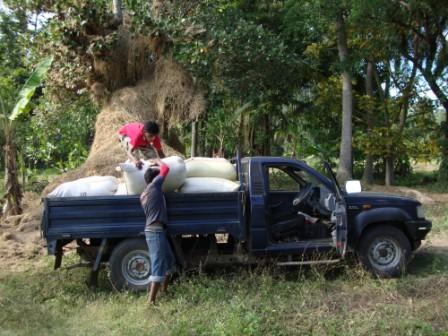
the final act is to load the paddy bags onto my pick up to take to my place to be stored for milling and delivery to my customers of fresh rice.

Tuesday, April 6, 2010

Amberella plucking – a great way to shake a tree and rain 200kg of fruit - (spondias dulcis)

There was this tree in my sister’s property loaded with Amberella, and even thought the fruit is smaller than on my trees, there were distinctly a huge amount. I would like to know if this is a budded tree that has got so big, as I don’t have budded varieties on my property, and the trees grow very tall, but here the branching seems to have happened from the bottom.

SHAKING THE TREE WITH THE LEGS TO RAIN AMBERELLA FRUIT ON THE GROUND

We determined the easiest way to pluck this was to shake the branches once we climbed the tree and it rained down on us. A few shakes later, the time it took to collect this lot was greater, whereas we should have laid a tarp on the ground and let it all fall into it to be bagged.


We cleaned half the fruit of the tree and got 200kg of fruit. While I retail my fruit on home delivery at Rs80/kg, what we I get at the wholesale market is another matter. The fruit once plucked cannot be kept for more than a week, and so has to be disposed off immediately. I am likely to get between Rs20 and Rs25 per kg, while if the fruit was a little larger a further Rs5kg would have been a likely price.

In the next door property, Gamini the neighbor told me that last week, he had collected 9 sacks of this fruit with still more left on the tree, and took it to the Dambulla wholesale market where he received Rs14,000. It is therefore possible that on the two fruiting seasons of a large Amberella Tree at its peak, one is able to harvest Rs30,000 of fruit on a wholesale basis. There is no care required, just the work in harvesting the fruit, and that only is just to shake and pick up!

I would not recommend anyone to grow a bud tree that fruits early, but the fruit is small, and hence my suspicion this may have been a budded tree that just grew and grew. The traditional tree grows 40 to 60f tall, but the wood is not worth anything. The fruit of the traditional tree is also about twice the size of the budded tree and fetches a higher price and the tree also yields a lot more fruit.


If only I could have made Amberella Chutney with this, I could have bottled and sold it over the months, but in the current state of the enterprise, I don’t have the expertise and time to do so. The tree grows quickly, but does not have an infinite life, with many dying after about 10 years. It is one fruit I think that probably yields pound for pound of tree weight more than any tree I can think of.

The various pics are of the fruit, tree, and the plucking and collecting process to interest the reader of the possible and normal. Thankfully this one crop was saved from theft.

Tuesday, March 30, 2010

UPFA agricultural policies are wrong, self serving, politically expedient, patronizing and most of all destructive- read on


The mess our agriculture is in due to the populist agenda that fools the people

I speak with considerable experience having been mired in both dry zone and wet zone agriculture for the past 6 years and being the only person in Sri Lanka who farms at the same minimal peasant allotments of between 5 and 10 acres, and produces about 50 different food items, including milk, eggs and coconut oil, that I transport personally, (me being the driver) and delivers to my shop and direct to consumers homes, I work through the day and drive through the night in order to keep my small business alive and the mouths fed.(about 35 directly)

I am harassed and delayed at night, by traffic cops seeking bakshish, checkpoints because I am easier to stop than a speeding Pajero, by security forces personnel just having to check someone to justify their enormous pay in comparison to farm workers who work harder for little reward.

I challenge all comers to a debate on the nuances of marginal agriculture that 90% of the so called farmers engage in, and the perpetuation of their poverty, by the current agricultural policies of the government with well meaning slogans that are blatantly wrong misleading and downright patronizing to the hardworking people of this country who are being completely fooled, bamboozled and coerced into voting for the wrong ideals, and subjecting them into a permanent poverty trap, to be exploited by these very same politicians pretending to be their saviors.

This government has been the bane of productive farmers by only assisting unproductive ones with wasteful subsidies and false promises of help. We need a complete policy shift that can benefit the vast majority of the people in this country and the government just does not get it. The people who know no better, believe in the parroted lies hoping to find relief in promises that realistically cannot be fulfilled unless there is a complete change of emphasis and direction aimed at productivity and excellence along with the tools to do so.

We produce agriculture graduates, to be government servants as extension officers who are the bane of the farmers as they know nothing and pretend to work, whilst we are in dire need of dedicated and trained agriculturists to run and manage larger units using their knowledge, coupled with the experience of growing in more productive units using the latest techniques with access to adequate funding.

Daily, I see this humongous fertilizer subsidy washed down the fields, by uneducated incompetent farmers whose costs, if their labor is fairly priced, far exceed the selling price of their products. The larger more productive farms that could use the subsidy wisely don’t get it and they still make a profit.

The biggest political lie is that we have convinced half the electorate that they are farmers, when they are not. A farmer is someone who produces a surplus of food over and above what he consumes. Only about 10% of those classified as farmers fall into this category. The others just happen to live on productive farmland in villas and think they are poor, but work as bureaucrats, policemen, hospital staff, bus drivers and shop keepers to name just a fraction of the areas that not just supplement their income but provide most of their income.

We continue with giving land to landless to keep them mired in poverty and beholden to the politicians for giving this land, instead of making better use of this agricultural land in a productive sense, and giving people housing nearer urban areas, so they can more usefully be able to reduce the commute times and costs, and have closer access to schools and hospitals in their inevitable jobs that cannot be sustained by farming. Give them 10 perches please and not three acres.

Only 10% of the heads of households in my area would be considered worthy of being called “knowledgeable farmers”. They lack productive land as useless wastrels living on government largesse (thugs, goons, party men who got free govt. land but live elsewhere, moonshine distillers, and those looking to make a buck out of exploitation of others) are occupying prime property, received by them or their ancestors free of charge.

I have a plan that will double the nation’s food output, with no extra inputs (this will reduce imports and increase exports) reduce the wastage and reduce the price of food for the consumer, while at the same time reducing the marginal so called farmer to be more productive in other fields where his abilities can be better rewarded. We cannot afford to give farming to the least educated, but should gradually encourage the most educated as it is the vocation with greatest risk, and thereby potentially the greatest reward, which people at the margin cannot hope to understand and therefore exploit for personal gain.

If you are in any doubt as to the practicality of what I propose, read the hundreds of pages in this blog which are devoted to all the aspects of improvements, which I have through personal suffering experienced and feel is needed if we are to get ahead. I am involved in almost all varieties of agricultural production in a practical sense including tea in the green and black tea production as well as organic and non organic methods. Just to add a little more power to my words, I am the only person in Sri Lanka that grows 6 varieties of paddy and has 15 varieties of my own rice, to sell direct to my customers, who I supply myself, albeit in a very limited scale as my land extent is small and I have very marginal land to grown in.

Sadly no one in this country has the guts to take on this monolothic giant that is unpatriotic, bent on keeping the people in serfdom so they can be autocratic rulers. Worst of all when they receive an overwhelming plebiscite they will actually believe they are right, when it is the slogans that did it.